Role of the NHS Board and Chair
NHS boards play a key role in shaping the strategy, vision and purpose of an organisation.
NHS boards hold the organisation to account for the delivery of strategy and ensure value for money. They are also responsible for assuring that risks to the organisation and the public are managed and mitigated effectively.
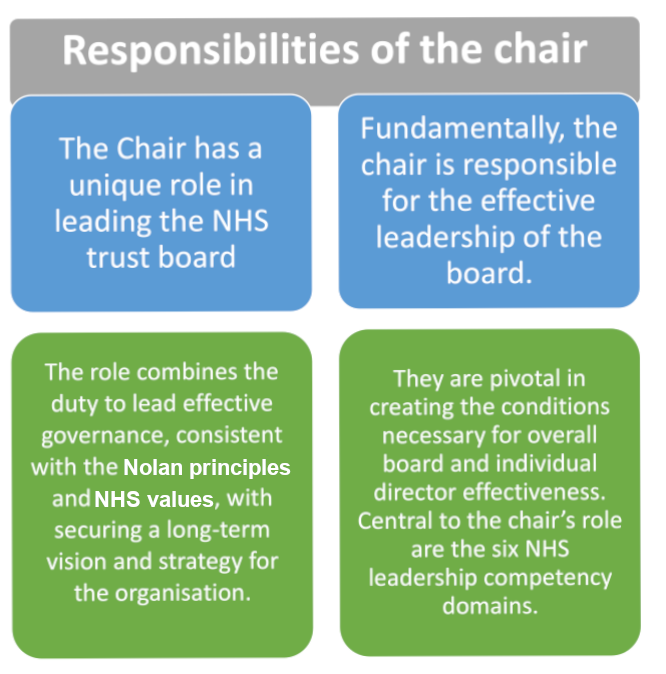
Led by an independent chair and composed of a mixture of both executive and independent non-executive members, the board has a collective responsibility for the performance of the organisation.
The Chair also ensures the Board is focused on improving outcomes in population health and healthcare, and fosters a culture of learning and continuous improvement, with a particular focus on quality, safety, access, patient experience.
The purpose of NHS boards is to govern effectively, and in so doing build patient, public and stakeholder confidence that their health and healthcare is in safe hands. This fundamental accountability to the public and stakeholders is delivered by building confidence:
- in the quality and safety of health services
- that resources are invested in a way that delivers optimal health outcomes
- in the accessibility and responsiveness of health services
- that patients and the public can help to shape health services to meet their needs
- that public money is spent in a way that is fair, efficient, effective and economic.
To carry out their role effectively, the chair must cultivate a strong, collaborative relationship with the chief executive. Many responsibilities in this role description will be discharged in partnership with the chief executive. It is important the chair and the chief executive are clear about their individual and shared roles, and their respective responsibilities towards the unitary board.
Together, the chair and the chief executive set the tone for the whole organisation. They are ultimately responsible for ensuring that the population the trust serves and the wider system in which the organisation sits receive the best possible care in a sustainable way.
NHS England has a specific role in appointing and supporting NHS trust chairs and non-executives. We are looking for an exceptional leader to chair Mid Yorkshire Teaching NHS Trust (MYTT). This is a unique opportunity to help shape the future of local services by sharing your talents and expertise to help transform the hospitals and make a positive difference to your community. MYTT is one of 5 acute hospital Trusts which sits within the West Yorkshire ICB footprint.
We are looking for candidates who want to use their energy, skills and experience to help drive the delivery of sustainable healthcare services for the people of North Kirklees and Wakefield, and surrounding areas.
Desirable experience
- Prior experience on an NHS board (executive, non-executive or associate role)
- Prior experience as a non-executive director (any sector)
- Prior experience working in complex, multi-site organisation.
- Professional qualification or equivalent experience
- Prior senior experience of complex organisations outside the NHS, i.e. private, voluntary or other public sector providers of similar scale
Required skills, experience and attributes are described in the NHS Leadership Competency Framework for Board Members set out below.
NHS Leadership Competency Framework
Leaders in the NHS help deliver better health and care for patients by setting the tone for their organisation, team culture and performance. We have worked with a wide range of leaders from across the NHS to help describe what we do when we operate at our best.
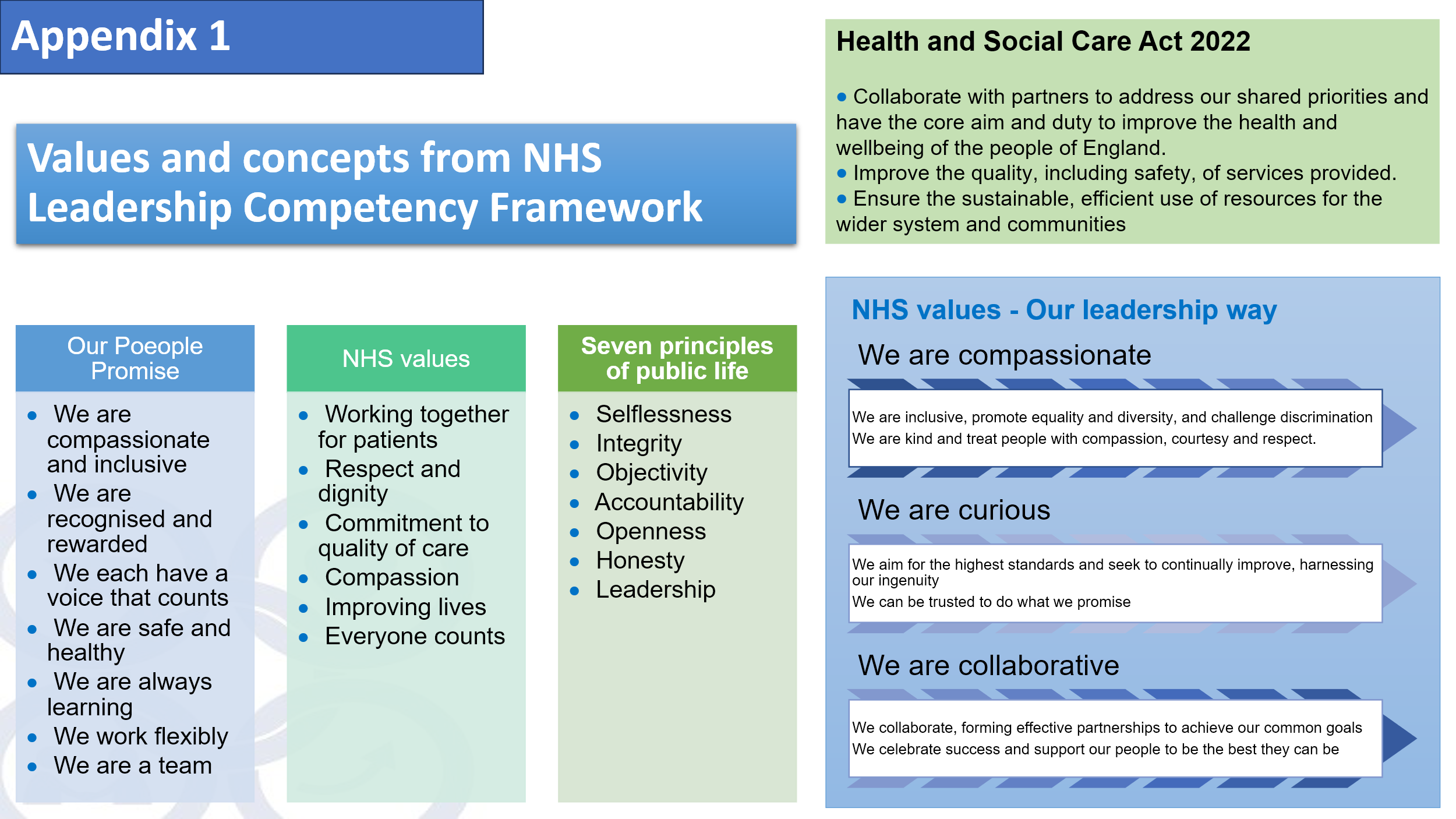
The competency domains are aligned to Our NHS People Promise, Our Leadership Way the Seven Principles of Public Life (Nolan Principles), appendix 1.
The competency domains reflect the NHS values and the following diagram shows how they are aligned: